Showing posts with label 9-11. Show all posts

Friday, September 11, 2015

9/11 Again

It's September 11th and for the first time, I'm in New York City on this date wondering what the day will bring and what I will do today.  I'm reposting the piece I wrote soon after 9/11 because it says how I feel.
__________________________________________________________________________________________

It would be hard to write something that hasn’t already been said or written about the tragedies on September 11th.  Having lived in Manhattan for eighteen years, I’ve always considered myself a New Yorker, but my affinity with the city goes back to a time before the World  Trade Center was built.  I was four, living in an apartment on Boulevard East in Weehawken,  New Jersey.  Our living room windows overlooked the Hudson River and I thought the Empire  State Building was our next-door neighbor.

Later, when we moved deeper into NJ, during high school, I traveled into the city by bus (on my own) two nights a week for Armenian dance rehearsals.  It is inconceivable to me now that at 15, my parents allowed me to go in and out of Port Authority on 42nd Street by myself and travel to Park Avenue midtown — returning home well after ten o’clock at night.  But times were different then. 

I loved going into the city — I felt so grown up in Manhattan.  So when I was away in Boston my first year in college (and miserably unhappy), I jumped at the opportunity to attend a small women’s college smack in the midst of the Upper East Side.

Though this next college experience had its drawbacks and disappointments, the best part was being in Manhattan.  I lived in the city from 1971 until 1989 and for the most part, adored every minute of it.  New York City was the only place I knew where at four in the morning you could go dancing, get a haircut, buy flowers, or eat anything your heart desired.  Not only was there every kind of food from all over the world — but it was being made by natives of that country and available in every price range!  For someone young and single, life there was a whirlwind experience of non-stop sensations.  But many years later, as new parents of young babies, those same exhilarating sensations became a constant bombardment of noise, smells, and an ever-present crush of humanity that flooded one’s life and made everyday-living-with-infants a real struggle.  The long-lasting honeymoon was over  it was time to move away.

So move we did but it was hard to be so far away from everyone we knew, especially with two-year-old twins. My husband started working for an airline so frequent trips back were possible. We wanted our kids to know New York the way we did.  With free airfare and so many of our family and friends still in New York (offering places to stay), each visit we explored more of our favorite haunts: Papaya King uptown and Zookie’s downtown for the greatest hot dogs [Unlike our first “Dog House” experience in the South where the hot dogs were actually red on the inside all-the-way-through when you bit into them!]; down to the World Trade towers to wait on that enormous line snaking its way atop the mezzanine to get our half-price tickets to Broadway; across Canal Street over to Chinatown to duck in and out of shops and eat dim sum and dumplings.  Of course, there were the usual visits to the Metropolitan, Natural History, and Modern Art museums, trips to Ellis Island and the top of the Statue of Liberty and Rockefeller Center, the Thanksgiving Day parade and 57th Street and Fifth Avenue at Christmas.  Though we no longer lived there (my son said apartment living was just too crowded for his taste) we felt connected still and our children had a sense of the place where they were born.

For my entire adult life, the Twin Towers anchored the skyline in Manhattan.  Larger than any structure one could imagine, incredulously they rose upward almost farther than one’s neck could crane.  Whether flying in, driving over from New Jersey, or staring out from Broad Channel, Queens over Jamaica Bay, there they were  planted firmly for all to see.

It was unthinkable that they could be toppled.  But on September 11th, with many, many watching, they sank before our eyes and with them our sense of forever.  The brother-in-law late to work, stuck in the subway; the cousin in a hotel across the street; the friend ten blocks away — thank God, all safe and sound.  All in our circle accounted for and alive but so, so, many others lost forever. Reactions of disbelief, shock, sorrow, fear, and depression eked their way into the mainstream of American life.  

After the attacks, our neighborhood Association down south decided to have a luminary tribute to the 250 victims on planes. A white paper bag for each victim.  Each small bag had the name of someone’s son, mother, daughter, father or friend.  As we lit each votive candle in their fragile paper holder edging our neighborhood park, I tried to say every name aloud:  Albert Dominguez, Patrick Quigley, Sonia Puopolo, Alfred Marchand, Garnet “Ace” Bailey, Betty Ong, Jesus Sanchez, Wolfgang Menzel.  My neighbor and I were conscious that we were moving bags and not body parts  it was little to do, but our candles and tears honored each of them.

When it came time to remove the bags, we couldn’t throw them away.  I kept my eight. Then we went to the Farmer’s Market and handed them out to people who offered to light them on their porches and in their homes. 
As Americans, until that day we had a false sense that we were untouchable. We never expected that those committed to using violence to convey their message would visit terror on our doorstep, anymore than we could imagine those towers would fall.  

Just after 9-11 during the National prayer service, I heard this phrase from Corinthians,

“What cannot be seen is eternal.” 

It’s been twenty-four years since I’ve lived in Manhattan. For me, the silhouette of those buildings will always be present. 

Friday, July 4, 2014

My New York Adventure - Part 2

Continuing my adventures in Manhattan, on Monday I traveled down to visit the Eldridge Street Synagogue, now a museum  a place I'd always wanted to see.  Though I'm not Jewish, I was curious about this house of worship built for the immigrant population cramming the tenements.  From the museum's website:

"Between 1880 and 1924, two and a half million East European Jews came to the United States. Close to 85 percent of them came to New York City, and approximately 75 percent of those settled initially on the Lower East Side.

The Eldridge Street Synagogue opened its doors at 12 Eldridge Street on September 4, 1887, just in time for the Jewish High Holidays. Hundreds of newly arrived immigrants from Russia and Poland gathered here to pray, socialize and build a community. It was the first time in America that Jews of Eastern Europe had built a synagogue from the ground up."
Lucky for me, I had a terrific docent, Miryam Wasserman who took us through the downstairs renovation and the glorious upstairs restoration where everything was as it was at the turn of the century  save for the new stained glass window (last shot below) to replace the original that was long gone.  The building is steeped in history that details the Jewish experience and how this synagogue created a united faith-based community of those from a widespread diaspora.  I learned a lot  including where the expression, "Don't throw the baby out with the bathwater!" came from.  


Sticking with the budget, after my immigrant experience, I traveled further on Eldridge Street and treated myself to an order of Chinese pork & scallion (yes scallions, but they were cooked) dumplings from Prosperity Dumpling  very tasty, filling, and best of all, the price: $1.00!

Well, my lower East side experience was wonderful (and there's still the Tenement Museum I've yet to visit) so on Tuesday I decided to venture even further downtown  to the 9/11 Memorial Museum.  If you go to their website two weeks in advance, you can sign up for free timed tickets on a Tuesday.  In my case, I didn't know in advance but you can get on line on a Tuesday, after 4pm and they start issuing tickets as available to go in at 5pm.  [Saved me $24.]

It is a magnificent tribute to the fallen and those who survived and I was particularly moved by the audio accounts of each incident pieced together (with timelines) by multiple individuals.   Brought to tears, I was touched by the thoughtfulness of the museum's tissue dispensers in these video rooms.  

In this case, a picture is truly worth a thousand words...

I had to take this in two shots and they don't
align perfectly but I hope you get the picture.


This shows where the piece of ruptured steel below came from in the building.


After an exhaustive experience I walked through the last three rooms without stopping  one on terrorism and the others on things following the tragedy.  I needed to leave and be outside.  The escalators up from the underground memorial showed this ...
The old World Trade Center
 and outside I was dwarfed by the sight of the tower that has risen in its place.

and the new WTC

Next time, a visit all the way north to Fifth 104th, El Museo del Barrio.

Wednesday, September 11, 2013

9/11 - Revisited

Detail of the Twin Towers from my 
1980 New York Design Fair poster  
21 years later they would be gone.
It would be hard to write something that hasn’t already been said or written about the tragedies on September 11th.  Having lived in Manhattan for eighteen years, I’ve always considered myself a New Yorker, but my affinity with the city goes back to a time before the World Trade Center was built.  I was four, living in an apartment on Boulevard East in Weehawken,New Jersey.  Our living room windows overlooked the Hudson River and I thought the Empire State Building was our next-door neighbor.

Later, when we moved deeper into NJ, during high school, I traveled into the city by bus (on my own) two nights a week for Armenian dance rehearsals.  It is inconceivable to me now that at 15, my parents allowed me to go in and out of Port Authority on 42nd Street by myself and travel to Park Avenue midtown — returning home well after ten o’clock at night.  But times were different then. 

I loved going into the city — I felt so grown up in Manhattan.  So when I was away in Boston my first year in college (and miserably unhappy), I jumped at the opportunity to attend a small women’s college smack in the midst of the Upper East Side.

Though this next college experience had its drawbacks and disappointments, the best part was being in Manhattan.  I lived in the city from 1971 until 1989 and for the most part, adored every minute of it.  New York City was the only place I knew where at four in the morning you could go dancing, get a haircut, buy flowers, or eat anything your heart desired.  Not only was there every kind of food from all over the world — but it was being made by natives of that country and available in every price range!  For someone young and single, life there was a whirlwind experience of non-stop sensations.  But many years later, as new parents of young babies, those same exhilarating sensations became a constant bombardment of noise, smells, and an ever-present crush of humanity that flooded one’s life and made everyday-living-with-infants a real struggle.  The long-lasting honeymoon was over  it was time to move away.

So move we did but it was hard to be so far away from everyone we knew, especially with two-year-old twins.  My husband started working for an airline so frequent trips back were possible. We wanted our kids to know New York the way we did.  With free airfare and so many of our family and friends still in New York (offering places to stay), each visit we explored more of our favorite haunts:


Papaya King uptown and Zookie’s downtown for the greatest hot dogs [Unlike our first “Dog House” experience in the South where the hot dogs were actually red on the inside all-the-way-through!]; down to Two World Trade Center to wait on that enormous line snaking its way atop the mezzanine to get our half-price tickets to a Broadway show; across Canal Street over to Chinatown to duck in and out of shops and eat dim sum and dumplings.  Of course, there were the usual visits to the Metropolitan, Natural History, and Modern Art museums, trips to Ellis Island and the top of the Statue of Liberty and Rockefeller Center, the Thanksgiving Day parade and 57th Street and Fifth Avenue at Christmas.  Though we no longer lived there (my son said apartment living was just too crowded for his taste) we felt connected still and our children had a sense of the place where they were born.

For my entire adult life, the Twin Towers anchored the skyline in Manhattan.  Larger than any structure one could imagine, incredulously they rose upward almost farther than one’s neck could crane.  Whether flying in, driving over from New Jersey, or staring out from Broad Channel, Queens across Jamaica Bay, there they were  planted firmly for all to see.

It was unthinkable that they could be toppled.  But on September 11th, with many, many watching, they sank before our eyes and with them our sense of forever.  The brother-in-law late to work, stuck in the subway; the cousin in a hotel across the street; the friend ten blocks away — thank God, all safe and sound.  All in our circle accounted for and alive but so, so, many others lost forever. Reactions of disbelief, shock, sorrow, fear, and depression eked their way into the mainstream of American life. 

After the attacks, our neighborhood Association down south decided to have a luminary tribute to the 250 victims on planes. A white paper bag for each victim.  Each small bag had the name of someone’s son, mother, daughter, father or friend.  


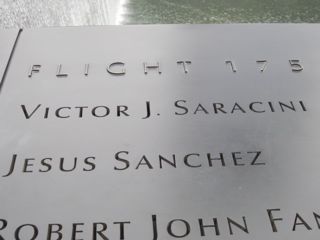
Four of "my" names at the 9/11 Memorial

As we lit each votive candle in their fragile paper holder edging our neighborhood park, I tried to say every name aloud:  Albert Dominguez, Patrick Quigley, Sonia Puopolo, Alfred Marchand, Garnet “Ace” Bailey, Betty Ong, Jesus Sanchez, Wolfgang Menzel.  My neighbor Katherine and I were conscious that we were moving bags and not body parts  it was little to do, but our candles and tears honored each of them.

When it came time to remove the bags, we couldn’t throw them away.  I kept my eight. Then we went to the Farmer’s Market and handed them out to people who offered to light them on their porches and in their homes. 

As Americans, until that day we had a false sense that we were untouchable. We never expected that those committed to using violence to convey their message would visit terror on our doorstep, anymore than we could imagine those towers would fall. 

During the National prayer service just after 9-11, I heard this phrase from Corinthians,

“What cannot be seen is eternal.”


It’s been twenty-two years since I’ve lived in Manhattan. For me, the silhouette of those buildings will always be present. 

This piece first appeared in a local independent newspaper in 2002 and then in this blog in 2011 titled "Indelible."  I just returned from a week in Manhattan and despite the new skyscrapers punctuating downtown  including the not-yet-open-for-business One World Trade Center (formerly the Freedom Tower)  my eyes still scanned the horizon for the sight of those iconic and missing towers.  
The glorious eastside view of lower Manhattan from the Brooklyn Promenade.
One World Trade Center is the tallest building with the spire.

Sunday, September 9, 2012

Indelible


It would be hard to write something that hasn’t already been said or written about the tragedies on September 11th.  Having lived in Manhattan for eighteen years, I’ve always considered myself a New Yorker, but my affinity with the city goes back to a time before the World Trade Center was built.  I was four, living in an apartment on Boulevard East in Weehawken, New Jersey.  Our living room windows overlooked the Hudson River and I thought the Empire State Building was our next-door neighbor.

Later, when we moved deeper into NJ, during high school, I traveled into the city by bus (on my own) two nights a week for Armenian dance rehearsals.  It is inconceivable to me now that at 15, my parents allowed me to go in and out of Port Authority on 42nd Street by myself and travel to Park Avenue midtown — returning home well after ten o’clock at night.  But times were different then. 

I loved going into the city — I felt so grown up in Manhattan.  So when I was away in Boston my first year in college (and miserably unhappy), I jumped at the opportunity to attend a small women’s college smack in the midst of the Upper East Side.

Though this next college experience had its drawbacks and disappointments, the best part was being in Manhattan.  I lived in the city from 1971 until 1989 and for the most part, adored every minute of it.  New York City was the only place I knew where at four in the morning you could go dancing, get a haircut, buy flowers, or eat anything your heart desired.  Not only was there every kind of food from all over the world — but it was being made by natives of that country and available in every price range!  For someone young and single, life there was a whirlwind experience of non-stop sensations.  But many years later, as new parents of young babies, those same exhilarating sensations became a constant bombardment of noise, smells, and an ever-present crush of humanity that flooded one’s life and made everyday-living-with-infants a real struggle.  The long-lasting honeymoon was over  it was time to move away.

So move we did but it was hard to be so far away from everyone we knew, especially with two-year-old twins.  My husband started working for an airline so frequent trips back were possible. We wanted our kids to know New York the way we did.  With free airfare and so many of our family and friends still in New York (offering places to stay), each visit we explored more of our favorite haunts: Papaya King uptown and Zookie’s downtown for the greatest hot dogs [Unlike our first “Dog House” experience in the South where the hot dogs were actually red on the inside all-the-way-through when you bit into them!]; down to the World Trade towers to wait on that enormous line snaking its way atop the mezzanine to get our half-price tickets to Broadway; across Canal Street over to Chinatown to duck in and out of shops and eat dim sum and dumplings.  Of course, there were the usual visits to the Metropolitan, Natural History, and Modern Art museums, trips to Ellis Island and the top of the Statue of Liberty and Rockefeller Center, the Thanksgiving Day parade and 57th Street and Fifth Avenue at Christmas.  Though we no longer lived there (my son said apartment living was just too crowded for his taste) we felt connected still and our children had a sense of the place where they were born.

For my entire adult life, the Twin Towers anchored the skyline in Manhattan.  Larger than any structure one could imagine, incredulously they rose upward almost farther than one’s neck could crane.  Whether flying in, driving over from New Jersey, or staring out from Broad Channel, Queens over Jamaica Bay, there they were  planted firmly for all to see.

It was unthinkable that they could be toppled.  But on September 11th, with many, many watching, they sank before our eyes and with them our sense of forever.  The brother-in-law late to work, stuck in the subway; the cousin in a hotel across the street; the friend ten blocks away — thank God, all safe and sound.  All in our circle accounted for and alive but so, so, many others lost forever. Reactions of disbelief, shock, sorrow, fear, and depression eked their way into the mainstream of American life. 

After the attacks, our neighborhood Association down south decided to have a luminary tribute to the 250 victims on planes. A white paper bag for each victim.  Each small bag had the name of someone’s son, mother, daughter, father or friend.  As we lit each votive candle in their fragile paper holder edging our neighborhood park, I tried to say every name aloud:  Albert Dominguez, Patrick Quigley, Sonia Puopolo, Alfred Marchand, Garnet “Ace” Bailey, Betty Ong, Jesus Sanchez, Wolfgang Menzel.  My neighbor and I were conscious that we were moving bags and not body parts  it was little to do, but our candles and tears honored each of them.

When it came time to remove the bags, we couldn’t throw them away.  I kept my eight. Then we went to the Farmer’s Market and handed them out to people who offered to light them on their porches and in their homes. 

As Americans, until that day we had a false sense that we were untouchable. We never expected that those committed to using violence to convey their message would visit terror on our doorstep, anymore than we could imagine those towers would fall. 

Just after 9-11 during the National prayer service, I heard this phrase from Corinthians,

“What cannot be seen is eternal.”

It’s been twelve years since I’ve lived in Manhattan. For me, the silhouette of those buildings will always be present. 
 
This piece first appeared in a local independent newspaper in 2002.  Now it's even longer since I've lived in Manhattan  21 years  and I still miss the sight every time I go "home."

Sunday, January 22, 2012

What I Don't Want To Hear

Last night we saw the film, Extremely Loud and Incredibly Close and it led me to share the story below which I wrote long ago and is related to 9-11 in a peripheral way, but also to say that in the film, a secondary character (William Black, played by Jeffrey Wright) shares with nine-yr-old Oskar (the protagonist, beautifully and skillfully played by Thomas Horn) that he was never close to his father and still how hurt he was that his father, at the end of his life, never reached out to him   to say he was sorry, to say he loved him. Even though it was only a movie, someone penned those lines for that actor.  It pains me that so many people share that sadness with me.
----------------------------------------------------------------------------------------------------------------------
My mom had always been the one who recognized that an education was the way out of living paycheck-to-paycheck. Sweating in a drycleaners (in the hundred-pound pressure of steam needed to press clothes), she wanted better for me.  Going to college in Boston had already been a traumatic event for my parents. They had never let me go to sleep-away camp and barely to slumber parties. It was not in their nature to have their children out of reach.  Along came an extraordinary opportunity to visit Lebanon for ten days — plane fare, hotel, most meals, all for just $300. It was beyond the scope of what my mother or I could imagine. A chance to go to the Middle East — despite their reservations and objections  I WAS GOING...


In 1971, I was an almost-18-yr-old- freshman at Northeastern University, first in my family to leave home and attend college. Months later, I had an extraordinary invitation to visit Lebanon for ten days and be part of an Armenian-American delegation traveling to Beirut to celebrate the opening of a youth center built with American dollars. In the 45-member US group, I was the only one who didn’t speak Armenian, so I felt fortunate to be included. I couldn’t believe how exciting it would be to travel halfway around the world. 

Just a week before leaving that April, a bomb exploded on the borders of Lebanon and began the civil war that continues today. That explosion shattered my parents’ consent. My mother called me in Boston. “You’re not going,” she said shakily, “it’s not safe.” But I persisted; I would never get this chance again. It was an opportunity-of-a-lifetime. It was highly educational. Eventually, she gave up arguing.

So anxious were their good-byes that I was one of the last to get on board and as a result got bumped up to first-class for the first leg of the trip to Paris. What luck! First-class was luxurious. The “stewardesses” served champagne and shrimp — it seemed a privileged fantasy. But 22-hours later, when we landed in Beirut, the picture changed drastically. Military men with stern faces lined every corridor, shoulder-to-shoulder, shouldering large rifles. We were on one side of a thick glass wall and those meeting the arrivals were on the other. Everything was being searched. I had never seen anything like it.

“Hey!” someone in our group called out, “people are looking for you.”

“That’s impossible, I don’t know anyone here.”

“Well, they’re holding up your picture.”

As I was guided down the length of the wall, there, pressed to the glass, I saw a picture of me taken at a wedding in Boston, less than three months before. There I was in my sleeveless, black-velvet, A-line dress with the fuchsia satin bow and three over-sized fuchsia satin-covered buttons. Bewildered I looked at the men and women, unknown to me, holding my photo. Somehow, I was known to them

After customs, I came face-to-face with this smiling, gesturing mother, father, two sisters, and a best friend — the family of two brothers who had emigrated to the US and were in the Armenian dance troop I belonged to. I knew the brothers, grown men 28 and 32 years old  but still, none of it made any sense to me. Finally someone who spoke Armenian got the full story. The brothers had written home (picture included) to tell the family that one or the other was planning to marry me.  They hadn't decided between them which  but as far as “the family” were concerned, I was the prospective daughter-in-law come to visit.

Though I objected that much as I liked both of them, I wasn’t marrying either of these men, over the course of the ten-day trip, my protestations were persistently brushed away. Each day, assorted members of this loving family escorted me everywhere — to and from the scheduled activities of the group, then shepherded me from house to house, cousin to cousin, one “showing” to the next. Though I kept trying to tell them otherwise, this was a culture where the men led and women followed without question I was showered with affection and presents for me and my family — handmade tablecloths, homemade liquor, suede shoes, and jewelry. I was drawn deeper and deeper into their fold.

Never speak until first spoken to.

Never refuse a drink (even if it’s 11 am or the third house you’ve visited that day).

Always kiss your hosts good-bye on both cheeks. I had more to learn.


Driving from Baalbek back to Beirut, I was sitting sandwiched between the two sisters when our car was pulled over by men in uniforms with guns and grenades. The trunk was opened; the car was searched, papers and passports had to be produced. 

“Wait a minute,” I protested, “you can’t do this. We haven’t done anything. Why are you searching the car?”

Both women elbowed me as the guards became very angry. The men in front turned ashen. They began to speak pleadingly in Arabic and gestured quickly with their hands; the only word I recognized was “American.” After what seemed to be an eternity, angrily the guns indicated we could leave. 

“What just happened?” I cried, but no one answered. 

The hour-long drive back was silent, except for my crying. When we arrived at my hotel, Dicran escorted me inside and gently explained. “You are American; you are used to speaking out. Your passport may protect you here, but it couldn’t help us. Here, we could be taken and never heard from — never, never, never do that again.”

Now, with the Twin Towers missing from Manhattan’s skyline, I go back to that moment forty years ago. Confronted with the possibility of routine searches and possibly the presence of the military in our everyday lives, I wonder: Is this the price that we must pay? And for some reason, in my head, I hear the names of seven people.  Seven people aboard American Airlines Flight 11 and United 175 — people I will never know but can’t forget: Alfred Marchand, Sonia Puopolo, Wolfgang Menzel, Betty Ong, Albert Dominguez, Garnet “Ace” Bailey, and Jesus Sanchez—and I worry, Yes.