Showing posts with label Teaching. Show all posts

Thursday, March 28, 2013

The Common Sense Approach to Education

Two 11-year olds, Simon and Alice, come back from recess and see their teacher hanging from a pipe in their classroom.  Really.

Monsieur Lazhar is a poignantly fabulous little film about "an Algerian immigrant seeking asylum in Montreal who replaces an elementary school teacher who committed suicide and helps the kids deal with their loss."  

The film transits how various adults in authority keep wanting to push the tragedy away and move on, while Bachir Lazhar — who has talked his way into being their substitute — desperately wants to allow the class to express what they're feeling.

I won't summarize the plot because as beautifully written and thought-provoking as it was, my focus was on something the film portrayed: How restrictive and rule-driven our educational system has become.   In trying to make sense of what he's supposed to teach, Monsieur Lazhar asks himself "...cross-curricular competencies ...what's that?"

When did we lose the common sense approach to teaching?

When did we stop trusting teachers to simply ask and assess if a student could: 
  • read, comprehend, intelligently discuss, extrapolate and apply information?
  • write an accurate, cohesive, succinct, and persuasive report?
  • manage money and be financially literate?
  • treat others with respect and compassion and act with integrity?
I know that isn't everything that kids should learn but we're so busy spelling out every single step that teachers can and CANNOT take that we've lost the essence of what teaching does when it's at its best:  guide kids to become happy, healthy, caring and contributing citizens of their local and global communities.

Monsieur Lazhar is instructed, cautioned, and later warned not to have any physical contact with the students.  He says he feels as if he needs to "treat kids like they're radioactive waste and keep hands off."  Though he doesn't even realize he's swatted a boy on the back of his head, throughout the film you can see the ache on his face when he longs to give a reassuring touch or a hug to these children who have been traumatized beyond what anyone could imagine.  

Instead of being able to use what's occurring in their young lives and address their emotional well-being, he must stick to the lesson plans and ignore the teachable moments that offer an opportunity to deal with their grief and loss.  Granted suicide is an extreme, but in the real lives of all our students someone dies, parents get divorced, jobs change, families move away. Shouldn't these be the things teachers also teach about in their classrooms? 

I am the product of many, many wonderful teachers who took a personal interest and nurtured me when that was absent in my home life.  When things were chaotic in my family (which was pretty often) I could always count on the stability and comfort of the classroom with my teacher.  

Were there exceptions and teachers who disappointed?  Yes.

Will every teacher reach every student?  No.

Will every teacher be a great teacher?  No, but what profession can boast 100% excellence?

And while we're at it, what other profession is constantly judged, regulated, and monitored by those outside the profession?  
Just because you've had a teacher doesn't mean you know how to be one.

I say put teaching back in the hands of teachers. 


Sunday, October 7, 2012

Valuing Teachers

I've written about teaching but I haven’t written about how disappointing it is that our society, this great American society, this culture of opportunities and riches, has failed for the past 50 years to truly value the work of K-12 teachers. I don’t know when things changed from being a society that reveres its teachers to one that treats teachers as if they were the lowest white-collar workers on the totem pole. 

Are there awful teachers? Yes.  Is being kept in your job when you're not doing it well acceptable?  No.  Should teachers be unaccountable for results?  Not completely. But are teachers the reason kids don’t learn?  Com’on.  You know better.  And when people are successful and receive awards for their accomplishments in those heartfelt speeches, whom do they recognize?  Their accountant?  Their lawyer?  Their doctor or banker?  They acknowledge the difference in their lives that a TEACHER made.  It only takes one great teacher to turn a life around.

Every now and then, films do a good job of recognizing and celebrating the life and sacrifice and commitment of an extraordinary teacher — Mr. Holland’s Opus, Lean On Me, Stand and Deliver, Dangerous Minds, The Ron Clark Story, Children of a Lesser God.

I recently saw a film on television that made me remember how hard it is to go in to a classroom when you’re a newbie.

Beyond the Blackboard is a Hallmark Hall of Fame TV-movie (2011) based on the book Nobody Don't Love Nobody by Stacey Bess, a first-time teacher who went into the dismal-est of situations to teach a group of homeless children in a shelter.  There is no classroom — just a crumbling, deteriorating room in a warehouse that is a mess.  With zero resources and little experience to draw on, Stacey (sincerely played by Emily Van Camp) is upset, overwhelmed and sinking. But she puts aside her personal expectations (like Shackleton) and perseveres to engage the children, and even tougher   she manages to engage their troubled parents.  It is a story of grit, sacrifice and commitment  traits of character every good teacher has  and Stacy has all those qualities plus integrity, because she continues to do what's right, even at great personal cost.

But beyond the dozen or so movies that celebrate these heroes in our lives and those of our children, how often do we honor and acknowledge what hard-working, gifted teachers do?  In fact, the better question is: How often do we denigrate the profession?  "Teachers.  They sure have it easy."  "Out at three every day?  Wish I had a job with summers off."  And the absolute worst insult: "Those who can do.  Those who can't teach."  


One way to value a teacher is that holiday or end-of-year gift. Those gifts could be a great way to thank teachers for all their hard work, but  as one teacher wrote (almost in a plea) all those mugs and trinkets (times 25, 30 or more students) are NOT appreciated  it would be FAR more valuable and appreciated "if everyone just chipped in a dollar or two for a gift certificate" that would allow teachers to get something they actually want and could use. I don't think that's too much to ask and it IS a better way to repay all the times a teacher has dug into her (or his) pocket for OUR kids. 

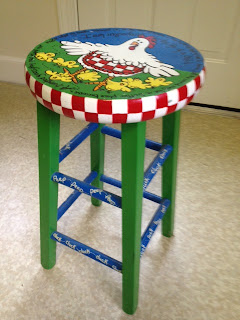
Yes, I've gotten my share of mugs (and regifted so many) but I must say, at times, I've been pretty lucky in the gift department. Some great Christmas ornaments that I've still got in my collection and when I see them on my tree, fondly remind me of that student and that class of kids.  But the best present I ever received was made by Marcus Deardorf's (?) mom.  Amazingly she hand-painted a stool  one for my team-teacher Nicole (with a cat wearing glasses just like hers) and this one for me 
with this quotation:

"A hundred years from now it will not matter what my bank account is, or the the sort of house I live in, or the kind of car I drive, but the world may be a better place because........I am important in the life of a child."

And what is the name of the teacher who made a difference in your life?  
Go on. Write below.  Thank that someone who understood you, made you feel special  and made all the difference in your world.

UPDATE: I happily reconnected with my team-teacher Nicole who sent me a picture of her stool which says something equally admiring of teachers...


A Teacher takes a hand,
                                            opens a mind,
    touches a heart.


http://www.mycutegraphics.com


Thursday, September 20, 2012

Character: The Sum of Who You Are

Perhaps there is a child, grandchild, or young person in your life you will send this to.  Then talk about it — who's your hero?
---------------------------------------------------------------------------------------------------------------------------------------------
char·ac·ter (kar ik ter) 5. a distinctive trait, quality, or attribute; characteristic 6. essential quality; nature; kind or sort 7. the pattern of  behavior or personality found in an individual or group; moral constitution 8. moral strength; self-discipline, fortitude, etc. 9. good reputation-----Websters New World Dictionary

In 5th grade I read a book club selection that stays with me still: Shackleton’s Valiant Voyage, an abridged version of the diary of Sir Ernest Shackleton by Alfred Lansing. Although it only cost 50 cents, I gained a lot from reading it. This was probably the first lesson I learned independently on the meaning of character. Shackleton was a British explorer who wanted to be the first to cross the Antarctic by land; he spent two years gathering the men, supplies, and ship to embark on an expedition. It was 1912, and Shackleton dreamed of making his mark on history. But before they ever got to land, their ship, the Endurance, was trapped and slowly crushed by the brutal polar ice. Imagine being stranded on a vast expanse of ice with twenty eight men counting on you. No one is coming to rescue you… no radio, no radar. The people back home in England 11,000 miles away don’t even expect to see you again for the next two years. If you were in charge, what would you do? How would you stand up under such enormous pressure?

Ernest Shackleton stands out as a person of character, because without hesitation he gave up what he most dearly wanted and pursued a new goal — to save every one of his men and to bring them back to their families. With endurance, perseverance, and a dose of humor, he guided his men in three open boats (the size of big rowboats!) across 800 miles of rough seas. In spite of all odds, under his command, they all made it back alive. It was a stunning tale of courage, bravery, and resolve.

Shackleton was my hero, and for years I told everyone I knew about him because he so inspired me. What I learned from reading about Shackleton was later summarized by my eighth grade class graduation motto: “Determination paves the road to success.” To this day, when people tell me I have staying power or guts, I think back to the lesson on character I learned from reading about Shackleton.

Your character is the sum of the qualities or features that make you who you are and guides your actions and reactions. It’s not about being smart or athletic or good-looking. It’s about being honest, fair, and considerate, and if you are those things then you stand a pretty good chance of being a person of good character with ethical behavior.

A person of good character goes through life always trying to do the right thing. Sometimes, doing what’s right isn’t easy. Learning is part of being a person of character. At any age, it can be helpful to think about what you can learn from others and what you can do to act with character.

What can you learn from others?
Reading biographies and autobiographies offers you an opportunity to examine the lives of others for their positive character traits. Instead of focusing only on an individual’s accomplishments, ask yourself: What character traits does this individual have that are admirable? Is the subject of the story someone who is kind and cares about others? Is the individual generous, courageous, or someone upon whom others can rely? How does this person act that sets him or her apart from others?

Along with biographies and autobiographies about real people, great literature can also provide opportunities for learning about character through fictional characters. The novel To Kill a Mockingbird is rich with characters who do and don’t do the right thing. When you’re reading ask yourself: How would I describe this individual’s character in one word? Is this person someone I’d like to be like? Positive and negative traits of character can be found by examining figures in science, art, history, mathematics, government, education, and industry.

Too much of our time can be spent watching television. But as you’re watching TV, try to look at the people in the drama or sitcom to see how they treat one another and what consequences their actions have—for both good and bad. How many times have you watched a show and thought to yourself, “Oh no…that’s a mistake…don’t do that, or it’s going to get you in big trouble!” Sometimes it can be helpful to see what others do and learn through someone else’s experience. Living vicariously, experiencing life through someone else, can be a valuable and safe way to learn a powerful lesson.

When you’re listening to music, watching movies, or playing video and computer games what messages are the lyrics, the plot, or the actors sending you? Are the messages in sync with your own values and thoughts?  Instead of simply absorbing someone else’s values, make sure that what you’re seeing and hearing promotes what you believe is valuable.

What can you do?
Being honest, fair, and considerate can be everyday occurrences. After you’ve given yourself a chance to examine character in others, practice behaving with character yourself. Start thinking about what you can do on a daily basis. Though everyone’s life is different, here are three situations that offer you an opportunity to act with character.

Resist cheating
The temptation to cheat exists. Most people say that the person most cheated by cheating is the cheater. Cheating cheats everybody.

Be true to yourself
Have you ever been tempted to hide your skills and talents trying to fit in?  You are who you are, and you need to be honest with others about yourself. You don’t have to be someone else in order to get someone else’s approval.

Don’t stay silent about bullying
Ever see a group of kids pick on or tease another kid? Has it ever happened to you? Well, take a stand against bullying. When a stronger person intimidates a weaker or more vulnerable person it’s wrong. The only reason bullying has become such a problem in schools is because most of us stay silent even when we know it’s not right. You can be a person of character by not allowing a bully to be in charge. Standing up for others can be as simple as saying, “That’s not how we treat each other in our school.”

If you can live your life being honest, fair, and considerate of others, then one day someone may be reading a book about you!    

[First published in newsletter for upper-elementary students who are academically accelerated.]

Sunday, September 16, 2012

Character

A gift from my friend Thelma
Before his acceptance speech for the Vice-Presidential spot on the 2012 Democratic ticket, in a video of his life story, Joe Biden told us that his mother always said "courage was the most important virtue and that everything else would flow from that."  It surprised me because I always felt the most important trait of character was either respect or honesty.  Later on in my life, honesty (telling the truth) changed to integrity when I understood the difference between “honesty” and “integrity.”  According to author Stephen Carter, integrity involves three steps:  integrity is discerning the difference between right and wrong, then acting on it — even if it’s at great personal cost.

Today, how often do we spend time talking to our kids or the other adults in our life about these traits?  Not enough.

We spend so much time, energy, money, and effort on teaching students academic skills but we don’t consistently and conscientiously teach them skills to enhance their character.  

Every day — in every school, in every state, in every classroom — kids take math.  Why is that?  Because we want students proficient in it. That’s a lot of class periods of math.

Reading.  Teachers really focus on reading (and should).  We incorporate reading in all that we can.  We have students read in school, read at home, have adults read to them, even have whole schools or whole cities read and discuss the same book — even discuss the movie.  Reading is a staple and should be.

But how much time do we spend on building a kid’s character?  Hard to say?  Certainly if/when time is being spent, parents and faith-based communities do the bulk of it.  And so do elementary school teachers — they pretty much weave character every day, in any way they can.  Some are doing it very creatively.  Good job.   And at minimum (for those less comfortable with character),  teachers can manage the trait of the month. (February is HONESTY. Abe Lincoln and all that — 

But somewhere around 4th to 5th grade, we drop those lessons out of their focus — just when things are getting tougher for kids. 

In another year or so, they leave the cushioned world of lower school (if they're lucky) where they may have been since kindergarten — with their same teachers, and their same classmates, from their same neighborhood. In elementary school, they knew what was expected (if they were lucky) — and it was the same up the hall or down — year after year. There is a certain amount of stability and strength in knowing what's what.

Just when they're feeling solid, we send them to middle school — with different kids from different neighborhoods, with different teachers (lots of them) who have different expectations (even different from one another) and different ideas of who they should be and how they should behave. They go off where everything changes, including expectations (most damagingly). If that weren't enough, to make matters worse — they’re bombarded with media.

I found this online:

According to a 2012 study from Yahoo! and ad agency Carat Interactive:
“The Internet has passed television in the amount of time spent a week, the Web portal and media firm found in a report called “Born to Be Wired” released Thursday. Young people, ages 13-24, spend an average of 16.7 hours a week online, excluding e-mail, compared to 13.6 hours watching TV. After TV viewing, they listened to radio for 12 hours, talked on the phone for 7.7 hours and spent six hours reading books and magazines for personal entertainment.”  

That works out to another SEVEN hours a day absorbing pop culture’s/movies and music's messages.  Messages which often are not only not about character, some of it actively promotes bad character.  Yeah bitch.

Pretty continuously our students have got all this @h#! consuming their non-school, non-sleeping leisure hours — not to mention Facebook (Tumblr, Foursquare, Pinterest, OK Cupid) and Twitter.  

And we can't carve out 50 dedicated minutes a week (let alone a DAY) to focus on developing their character and giving them cognitive and social opportunities to practice navigating their ethical challenges and hanging on to their moral compass in spite of all that @h#! ? 

And we're the adults here?

Sunday, June 17, 2012

The Turnaround

To fully understand and perhaps appreciate this post, you need to have read Falling Short Part One and Part Two...
------------------------------------------------------------------------------------------------------------------------------------------- 
I'd been gone from my class for over a month. My world was now consumed with breastfeeding, changing, bathing, and loving two babies. We were planning to move out of the city.  Things were in flux.

When the phone rang I was surprised it was Judy Budd, my principal.


"You'll never guess who marched himself into my office today." she said. I could hear the grin on her face through the telephone.

"Who?"

"James Walker."

James did everything in his power to avoid the principal's office but he inevitably landed there.

"James ?" I asked in shock. "Why ?

"He said,

'If you don't move me outta that room I'm gonna get in big trouble.' Can you believe it?"

I couldn't. I could not believe it.

"What did you do?"

"I moved him into Cindy DeJoie's room."

I smiled from ear-to-ear. Cindy was called "the drill sergeant" by the rest of us. If anyone could keep James in line — it would be her. She was young, tough, caring. A great teacher.

"You have to hand it to him," Judy said instructively, "It was a pretty mature thing to do."

So. There was hope for James Walker after all.

And for me.

Monday, May 28, 2012

Falling Short - Part Two

Home in our apartment, flat out in bed with belly protruding, I could tell exactly when it was 3:20 because the phone would ring and it would be one or more of the girls from class calling to tell me what a mess the day had been.


“The teacher was fighting with the boys!”

"Jabbar fell asleep in class!"

“No one did their homework!”

“Karim was climbing on the cabinets!”

“She let us have SODA!”

Things were falling apart. My replacement was a brand-new first-time teacher who had just graduated in December.  She was young and green and they were eating her alive.  Even my colleagues (when I pressed) reluctantly told me the kids were "swinging from the rafters." 

The calls went on day after day. Shamefully, I began to avoid answering the phone after three o’clock. I didn’t want to hear. I didn’t want to know what was happening.

What was happening?  Why were they acting up?  Why weren't they behaving as they had learned to behave?  What had changed?

Just one thing.  Only one thing had changed.

I was gone.  And with me went all that I'd worked so hard to instill. All they'd worked so hard to achieve, all that struggling, all that striving.  Turns out they didn't do any of it for themselves, they did it to please me.  I failed to teach them that they should make the most of their skills and talents because of what it would mean to them — I didn't know enough to teach them that.  Everything they did, they did out of a desire to please their teacher. And once the teacher was gone, so was the behavior.  All I had accomplished was to make them loyal to me.   

All they had gained under my tutelage soon fell by the wayside.  

It would take me decades to figure out how NOT to make that mistake again.
------------------------------------------------------------------------------------------------------------
Read the conclusion to this tale in The Turnaround

Thursday, May 24, 2012

Falling Short - Part One

It wasn’t until I was forced to leave teaching and go on bed rest that I found out how I had failed my students.  Though I'd tried to impart to my class all I had learned from my teachers there was a fatal flaw…and it wouldn't become known to me until it was too late to remedy.
--------------------------------------------------------------------------------------------------------------------------------------------
It was inevitable.  In two weeks I would have to stop teaching and go on bed rest.  Though my principal Miss Budd had made every accommodation she could to make it possible to stay, my doctor said if I continued working I'd be endangering my twin pregnancy.  

Twins often came early, premature and with complications.  To minimize the risk to their physical well-being you had to make it to at least 32 weeks to avoid respiratory distress syndrome (lungs not fully formed to support healthy breathing). Thirty-six weeks was even better.  At 36 weeks they’d still be premature but more fully developed.  If I was going to make it to either of those milestones I had to stop working and go on fairly complete bed rest.  I’d contracted shingles, had gestational diabetes, and my doctor cautioned I couldn’t put it off any longer.  I had to quit.

Though I hated to admit it, truthfully, continuing to work had been tough. In spite of my colleagues pitching in and helping out, even with the kids being so good, working was taking its toll.  I’d thought I was doing such a great thing by eating fresh fruit and drinking juices five or six times a day  until my fasting test showed I had gestational diabetes.  I needed to cut down on the sugars and monitor my blood five times a day, twice during school hours.

I couldn’t leave the room and hike down the stairs to a faculty bathroom every time so, I decided to make it part of the day’s lessons. The kids could track the level of my blood sugar and plot it on a graph posted on a bulletin board in the room.  They could compare and contrast how I was doing within a day, day-to-day, or week to-week.  They liked recording the number, plotting the point, drawing the lines, making predictions.

In those days the high-tech glucometer was a hand-held gun that allowed you to stick a disposable needle  a lancet  in the machine, shoot yourself in a fingertip, press to get a drop of blood, then stick a litmus-like tab of paper in the blood, slide the paper tab into the meter and wait for the reading to register and appear digitally.  Then you had to write down the number, carefully place the lancet and the tab in a safety bag for disposable.  Twice a day the kids would gather around my desk while I went through this ritual.  The boys couldn't wait to hear that trigger pop and see the blood slowly emerge   the girls held back and cried.  They were convinced that it was hurting me.  I tried reassuring them, laughing even, but after awhile my fingertip pads were marked and sore and I couldn't laugh it off.

The day had been particularly long. I'd been standing on my feet too much (carrying the weight of twins) and cramming it in so the kids would have as much as possible in their heads before the dreaded “test.”  There was no telling who would come in and replace me. It certainly wouldn't be an established teacher — they’d all be in jobs already.  I was stressed and worried and felt guilty and adding to my anxiety that moment, I was teaching my absolute least favorite subject in the world…math.

I sent the next group of three to the board to work out some multiplication problems.  Class clown James was trying my patience by sauntering up to the board and doing what my mother would call “lolly-gagging.” The other two students quickly did their calculations; we checked the math, they sat down.  James was standing there with his trademark grin on his face and fooling around with the chalk.

“James," I said impatiently, "just work on the first set of numbers.  Just look at the first numbers to multiply.  What’s 3 times 4?”

He jerked around grinning, giving me what he thought was an endearing look.  


“I don’t know…” he drawled and everyone burst into laughter.  Grinning and laughing, James was enjoying the comedic moment.  

I wasn't laughing  I was livid.  If I'd told him once, I'd told him a hundred times. He had to memorize those times tables.  


I had spent months trying to get James to work to his potential.  Praised, cajoled, reasoned, given him a hug, a kick in the pants, anything I thought might work.  Despite his poor grades, to me he was a smart kid.  There were glimpses of his intelligence but the only role models he saw around him in his neighborhood were non-productive adults.  The three "D"s were part-and-parcel of the adults he knew outside of school  drinking, dealing, and drugs.

“Class.” 


Everyone turned to me, still laughing, but curious about the tone in my voice, not one they'd heard.


“Class.  Are you laughing WITH James or AT James?” and James turned to the class  still enjoying being at center of it all and still laughing when they called out loud and clear “AT HIM !!”   


The smile disappeared from his face.  He got angry, turned to me with fury in his eyes and said, “I didn't know that because I thought you asked me, What’s 4 times 3 !!”


And at that I put my hands on the board and moved my head forward and back as if I were bashing my forehead into the blackboard over and over in sheer frustration. The class thought it was hysterical.


I turned to him.  “James.  If you don’t know that 3 times 4 is the SAME as 4 times 3 — then I give up. I GIVE UP.  You say you want to be a pilot?  What do you think that control panel in the cockpit is made of?  Dials with NUMBERS.  NUMBERS THAT REQUIRE MATH.  Did you think the plane was gonna FLY ITSELF?  SIT DOWN.  I’m through. I wash my hands. No more talks, no more trying to get you to learn, no more sessions after school — I'm DONE.”


The class had gone quiet. James had taken his seat.  He had a steely look on his face.  His eyes were filled with bitterness.  It was a terrible way to treat a student. It was awful.  I was awful.


After that, James stopped talking to me.  He was in class but he wasn't present.  He didn’t act up but he didn’t look at me and he didn’t speak to me.  I tried pleading. I don't remember but I hope I said I was sorry. I do remember saying to him, “James. You can’t keep this up. I’m leaving in a few days.  Please.  Is that the way you want to say goodbye?”


But for those two weeks he just avoided talking.  Maybe on my last day he might have mumbled "goodbye."  I don't remember.  I only remember I left feeling I’d fail him.  


Soon it would get worse.


Thursday, April 26, 2012

All of My Children

I came to teaching in a very backhanded way. I’d always loved my teachers (well almost always) and it seemed to me that teachers made a great difference in one’s life. I wanted to make that difference. I wanted to be in a place where I could do for some children what my teachers had done for me  save me. I wanted to throw out the lifeline that would reel them in and hold them tight and not allow them to feel that they were simply adrift at sea with no anchor, no shore. For a short time I became a teacher and the classroom with the experience of many personalities  all affecting you in some way, many ways  was a place I had always wanted to be. I got that chance in my mid-thirties.
-------------------------------------------------------------------------------------------------------------------------------------------
I’d just begun my first teaching job in the heart of Manhattan’s Upper West Side...a job I went to later in life and without the proper training.  I was scared — a class of thirty-one fifth and sixth graders, some bigger than I was!  Still, in my heart of hearts I knew  I was meant to be a teacher.  It was just a matter of figuring out how.

Those first weeks, I came home drained and worried:  their lives were so troubled.  How was I going to give everyone what was needed?  Would I focus on the few bright ones that needed to be challenged to their potential before they were “bored” out of school?  Should I concentrate on keeping the ones who were on-grade-level on-track?  Or should I pour the bulk of my efforts into the struggling, barely scraping by, cohort of kids who seemed to have little chance of ever succeeding? I didn’t know and without any teaching experience to fall back on, I troubled over these choices again and again before falling 
asleep each night. It was making me sick to my stomach.

As time inched by, I grew more confident and less naive. I began to learn more and more about the “real world” my kids l
ived in — a world foreign to me.  Their world (a world I truly didn't know) intruded on us daily  when we had to clear our macadam schoolyard 
of the used condoms, broken glass, and empty syringes before playing kickball.

My education started the day half my class came in bleary-eyed. Why? Because early that morning a SWAT team had descende
d on their building trying to flush out a suspected "cop killer."  Police with machine guns and dogs had roused them crack-of-dawn out of 
their beds, scaring them out of their skins.

I continued to learn about the world of my students through class assignments.

Writing letters to then President-Elect Bush (the first) yielded a surprise when I innocently began sharing them alo
ud to the class: 
“Dear President-Elect Bush, I don’t think mothers should be allowed to use hot irons or hangers on their children…Sincerely, Natalie.”  
That taught me to pre-read their writing before sharing.

The assignment to “dr
aw a picture of a room in your home” produced a believable depiction of 11-year-old Selena being straddled in bed by a male stick-figure (her step-grandfather, I later learned). She'd carefully drawn her younger sister and brother standing nearby, watching.

Or the twin who when it was his turn to answer, "What will you do over the holiday break?" kept insisting tha
t he was going to stay in our classroom, by himself, all vacation. No matter how I tried to convince him otherwise, he told me he wasn’t going to leave our classroom to go home. I had him stay in at recess  trying to elicit what was going on.  On an impulse I had him look in the mirror.  “Tell me what you see, Robert,” I asked. “Nothing,” he replied, “nothing.”

Emotionally, physically and sexually abused faces eagerly greeted me each morning — looking for all I cou
ld give.  No wonder I felt sick every day.  But my husband didn’t buy it.  “This is nuts,” he persisted, “what if you have cancer or something?  You’ve got to 
get checked out.” And so I did.

I didn’t expec
t to be pregnant.  I’d just taken on this new job and had my hands full with thirty-one kids; I didn’t need another.  Still, except for being surprised at the timing, 
we’d both always wanted to be parents and were genuinely happy about it.

My class was delighted.

Six weeks later the midwife I was seeing told me that she thought I might be carrying twins. “
What would make you say that?”  I asked.  She explained that due to the height of my fundus (whatever that was) I was either a month further along than I thought, incredibly constipated, had fibroid tumors or was pregnant with twins.  “But no one in 
our families has twins,” I protested. “Well, they have to start some place,” she smiled.

I almost didn’t tell my husband, but of course did. He lit up at the possibility, then absorbed the shock on my face.

“How will we know?”

“My sonogram on the 16th.”

We had a month
 to go. Two weeks later for my birthday he gave me this unusual pair of  pins — Scottie dogs: one red with a black bow and one black with a red bow  tiny contrasting satin bows around their little plastic necks.  They were darling.

“Just in case," he said dog-ishly.

I’d never been a parent but imagined it would be hard enough with one, let alone two babies and besides,
 I didn’t think it was possible.  I’d had two abortions in my past and always felt that somewhere along the way God would punish me for them.  No matter that one of these pregnancies was headed for a miscarriage and the doctor who assessed me determined I was in no shape to wait out Mother Nature’s timetable.  Both times I had entered into the sex for the benefit of someone else but to the detriment of me.  I 
pushed the thought of “two” out of my mind.

But much like an American Express television commercial airing at that time, my husband and I received the astounding news during the sonogram. Splayed on a table, in an unfamiliar office, covered with jelly, gauges, and straps, the doctor (unknown to us) asked, “Is this your first sonogram?”

I answered "Yes."

“You’ve never had an ultrasound?”

“No.”

“You mean this is the first sonogram you’ve had during this pregnancy?”

Skittish and exasperated I barked, “Why do you keep asking me that? This is the first time I’ve had a sonogram. You've asked me THREE times already — why would I lie about it?!”

My husband was gripping my hand gently, hoping I’d calm down. We were both anxious and this klutz wasn’t helping things.

“Well, I’ve got a surprise for you. I see two. I see two in there.”


“I don’t see two,” my husband said in disbelief.  But the doctor just circled on the monitor “Twin A.  Twin B” and we stared with our mouths gaping.

It was funny how everything changed that day.  It was like finding out all over again that you were pregnant.  A lot was gonna change.  We couldn’t stay in our apartment, not enough room.  My salary wouldn’t cover daycare costs for two.  Before, we didn’t want to know in advance what sex we were having. Now, we needed to know.  

We told no one the news until we could get acclimated to it ourselves. 

I was in my mid-thirties and having boy-girl twins.  I took it as a sign of God’s forgiveness.  We were being blessed with an incredible gift I didn’t deserve.  I was stunned by the symmetry of it.

It soon became clear that I could no longer continue teaching. There were consecutive complications, all fairly serious, all pointing to the urgent need for complete bed rest. Though I’d explained to the class that my doctor insisted I stop working, and that the safety of all three of us was the only reason I was leaving, my kids still looked at me with acute disappointment in their accusing stares. Yet one more adult in their young lives abandoning them. No matter what I said, their faces let me know I was making a choice and I wasn’t choosing them. 


The price of my gift became apparent. 

Two for thirty-one: painful as it was, I was grateful for the choice.

Thursday, April 12, 2012

Mister Burson Wasn't a Nice Person

To My Readers: 

If you want to receive an alert when I post, scroll all the way down to the end of this page and click on Subscribe to: Posts (Atom)
--------------------------------------------------------------------------------------------------------------------------------------
I know it’s going to sound as if I was a real rebel in high school but honestly I wasn't.  Most of the time I was running around from activity to activity like Little Mary Sunshine except I was miserable inside. 

I always had a hard time with math.  In some part I attributed this to a change in schools when I was in fifth grade.  In my new school they had already covered fractions and I missed the foundations on that and thereafter struggled with certain basic concepts.  This was before there were calculators available on every device in your life. You couldn't avoid math.  You had to take algebra and geometry if you planned to go to college so  algebra and geometry it was.  My algebra teacher, Mr.Viglione, was a kind-hearted easy-going guy who coaxed me through the class and was always encouraging.  My experience with geometry was quite the opposite.

Mr. Burson was a short uptight Pee-Wee Herman-looking guy who had slicked-back hair, wore a suit and had this precise character about him.  Everything FIT.  Except for me.  Those angles and planes never seemed to add up and he was annoyed each and every time I asked a question in class — which was frequently.  He always answered, but in a way that didn’t always help me get to the answer and he replied with such disdain that eventually I stopped asking.  Still I had to pass and it was looking doubtful I’d get by with more than a D.  

Now for someone who is used to A’s a D is a blow.  And I had the kind of father who ONLY saw the misses.  If I brought home a report card with all A’s except for one C in Algebra, he’d bellow, “What’s this C?”  If the next marking period that C was a B and I had a C in Phys Ed, he’d say, “Well, you know gym is important TOO.”  I couldn’t win.  Not with my dad and certainly not with Mr. Burson.


One particularly difficult class (could it have been cosigns and tangents or are those not parts of geometry?) I kept asking questions because I knew we’d have a test and these would be on it.  I guess his limit was reached when he shouted (and if I’m not mistaken, threw a piece of chalk at me), “What’s the matter with you, are you stupid or something?!”  Well that did it for me.  No matter how I looked at it, he was the teacher and it was his job to teach me and it certainly wasn’t to humiliate me.  In my 10th grade superiority I gathered my books and notebooks, got up and left the class, went straight down to the Assistant Principal’s office, fuming and furious. 

Mr. Herold tried to get me to calm down but I had one thing in mind: I wasn’t going back in there until the weasel apologized.

“Be reasonable,” he said.

“It’s not my fault he can’t do his job.  HIS job is to teach me and if he can’t find a way to make the subject understandable — then I guess HE must be stupid!” I shot back.

“You don’t mean that.  This is a simple misunderstanding,” he entreated, trying to get me to calm down.

“Oh no, it’s not.  He called me stupid in front of the entire class!  I AM NOT stupid!  AND he needs to apologize to me in front of everyone or I’m not going back.” I stubbornly dug my heels in, hugging my books tighter to my chest.

“Well, let me see what I can do.  Take a seat outside in the office until next period. And work on your Geometry!” he nudged smilingly.  I really liked Mr. Herold. He was a real adult but a straight shooter with kids.  Not all that huff-and-puff authority stuff like the principal, just a real guy who seemed to like kids and want to help them.  

“Come see me after last period.”

After all these years I don’t know if it’s just a figment of my imagination but in my mind at the end of that day Mr. Burson was in Mr. Herold's office and apologized for losing his temper —  begrudgingly — without ever looking me in the eye.  I felt the satisfaction of having HIM a bit humiliated in kind, but it wasn't in front of the class.  Still I knew there were limits to what I could demand — even when right is right.

When I was a teacher you’d think I’d have learned the lesson that humiliation was not an appropriate strategy in the classroom but there was a time  once  when my patience was tested, when nothing else had worked, and so, I resorted to humiliation. Immediately after I'd done the deed, I wasn't proud of it. 

James Walker, wherever you are, I hope you’ve forgiven me.