Showing posts with label Italy. Show all posts

Sunday, October 14, 2012

Among the Ruins in Rome

While I'm away on a little mini-vacation, I'm taking you back to our BIG vaaction.  Back to Italy for a quick visit to Rome.
--------------------------------------------------------------------------------------------------------------------------------------------
In spite of what everyone has advised, we are here in the Roman Forum at 1:30 pm on a hot, hot,hot day in the extreme sun — midday in the peak of the heat.  We have spent the morning at the Coliseum, luckily a 15-minute walk from our hotel because there is a transit strike today.  You really don't comprehend its magnificence until you are right smack up against in, in it, and see the size of you and the enormity of it.  How could it ever be built in those times and still standing?

My husband Chris is the historian of the family.  The one who immerses himself in the past and enjoys every bit of minutia he can find on just about any subject.  The Romans ?  Absolutely.  I feel awful because the Rick Steves audio tour of the Forum and the Coliseum I now cannot find on my still-new-to-me iPhone.  Fortunately we got the studio guide to the Coliseum though coordinating the guide, the map and the buttons was a challenge to we Luddites.  I ask a teenager from Canada who tries to find them but has no luck.  I feel better. It’s not just me.

All those Hollywood films Spartacus, Barabbas, Ben-Hur, Gladiator — they come to life here as you see the crumbling monument of what was the real spectacle — the Coliseum, this massive structure of spectacular proportions.


Having circled high and low for hours, we've made our way to what remains of the Forum, but I cannot take another hour of rocky remains in the blistering sun. While Christopher trudges toward the Temple of Castor and Pollux and the Rostrum and the Arch of Septimius, I sit in the shade on a millennia-old block of marble while the breeze blows soothingly on me and all around people are starting and stopping, checking their maps and guide books, babbling in Russian, German, Italian, and Japanese.  Across the expanse of ruins, testament to the glory that was and is Rome, I see my husband, a speck in the distance — another tourist soaking up the history, archaeology and topography of the ancient city.  Then I lose sight of him in the sea of specks and after five minutes begin worrying that he's collapsed behind a pile of Roman rubble with sunstroke.  

This feeling of panic reminds me of another vacation long ago when we took the kids to see the Grand Canyon. 

They all wanted to climb down into the canyon.  We started out at 8:30 am but I know my limits — it looked scary.  People on mules went skittering by.  It was brutally hot but the three of them wanted to start down a ways, so I said I would wait.  We found a small rock niche where I could sit in a bit of shade, and off they went. Two hours went by.  They didn’t come back.  I screwed up my courage and slowly walked down, keeping as far from the edge as I could, hugging the canyon wall without scraping my skin against the rock.  I went through a big arch and rounded a bend and didn't see them anywhere.  I turned and headed back to my little rock perch.  Three hours had gone by and I was panicking.  People who had walked down the canyon well after they did were coming back. I began asking people, “Did you see a guy with a bandanna and two teenagers down there?”  No one had.  My panic was rising. I stopped a ranger told him that he needed to get help, that I was sure something had happened to my husband and the my kids.  They had no hats, no water, nothing.

The ranger wiped the sweat from his brow and said patiently, “M'am, if they left before 8:30 this morning and haven’t come back, then they’ve gone down to the three-mile point and won’t be back for at least another hour. Get out of the sun. Get something to eat.  They’ll be back by then.”

So I trudged back to the room at the lodge took a shower and laid down to wait.  And sometime around 2:30 that afternoon (actually 2:20 pm, almost six hours after they left) my son burst into the room, dripping sweat, covered in red dust and dirt, yelling, “MOM! MOM! MOM! We’re OK!  I ran ahead, because I knew you’d be worried but they’re coming — and we’re all okay!!!”

This time the wait was not six hours but more like forty-five minutes. Chris emerged wiping the sweat from his brow — eager to tell me about all he'd seen — here among the ruins in Rome.

Thursday, September 6, 2012

You Gotta Have Art

Throughout this trip I have been looking for art.  Art to take home and enjoy and have as a remembrance of our travels. I have not been hitting it.  We are on our way back to an art gallery where I saw something I really liked the other day but didn't want to spend the money.  So we are traveling through Venice, when I pass by and spy two very small oil paintings in the window of a lovely nook of a bookstore  I am curious, so we go inside where we find books piled upon books upon books upon books.  Scanning the cluttered premises, I immediately see and fall for a small framed watercolor  all soft grays and greens  of a boat suspended over a dock.  It is utterly simple and beautiful.  

"OOOH. What is this?" I cry to the slightly disheveled middle-aged man with spectacles seated behind an over-piled desk.

"It's not for sale.  It's the only thing in the shop that's not for sale.  It's the only painting that exists that was done by my father," and this leads us into conversation with this British ex-pat who has lived in Venice and sees the world from his small stuffed library of a shop.  Chris buys a tiny Oxford University Press book Marlowe's 'Faustus" and Goethe's 'Faust' and we move onward to find Scriba the small gallery where I  again torture the poor young and hip saleswoman by pouring over again and again the pointillist work of Rosario Morra which I find quite compelling.  I can't make up my mind.  We ask Alessandra where SHE would eat and, very helpfully she writes down the places she would go. One of them is ai Promessi Sposi on the Calle dell'Oca.  We think this will be the place to head for and we start our quest.  It turns into an overly long and winding trip through the maze of calles and campi and canals.


We bought this art of  the Jewish Ghetto because it
reminded us 
of how we felt in the Jewish Ghetto. 

As we wend our way through some very narrow and steep alleys that are almost claustrophobic, I think of our guidebooks — that because it was a confined area for the Jews, they  were allowed to build higher than elsewhere in Venice.  As the sky darkens and the building walls seem to be closing in, thinking we are yet again lost there in the middle of the alley stands Valentina from our first night at Antice Stellato!  She is smoking outside the restaurant next to a chef who is eating from a handheld plate of food.

”It’s the James Family!” she announces to her friend, who looks at her, startled that she knows this strange couple approaching.

“Valentina!” we sing out, smiling to find her here, knowing that the food inside will be good. "Someone told us to come here and"

“You must, you must, you MUST have the beef tartare! It is magnifico!" she interrupts, "and the orechietto with caper pesto!  You will LOVE it!!!”

We are introduced to her friend (who had a Greek god's name I can't remember), chat a bit and then head inside to find a cozy and romantic place with cream-colored walls, rustic wood-beamed ceilings, handkerchief-covered light pendants  and Frank Sinatra and Tony Bennett playing in the background.  It is perfect and so is our beef tartare, pasta and wine.

As we come and go down our fondamente, we pass by these magnificent doors day and night. The door knobs are crowned heads in brass.  Our time in Venice is coming to a close.

Sunday, September 2, 2012

Pittoresco Torcello

Torcello is one of three islands off the coast of Venice and perhaps the least visited.  Murano is known for its glass, Burano for its colorful buildings and its lace and Torcello, well Torcello was where the Venetians came BEFORE there was Venice.  We decide that it’s Torcello we really want to see and while everyone has said (“You must see Murano! You must see the glass!  You must see the lace!”) the idea of traipsing through a factory that makes glass under hot temperatures when it’s already incredibly hot, is too much to consider.  Besides. We only have a limited time and it’s overwhelming to think of seeing all three islands so we buy a 24-hour pass, jump aboard a vaporetto outside our hotel door, and change at Fondamente Nove to take the fairly long boat ride to Torcello by way of Burano.  I’ve noticed that my feet are sunburned in the pattern of the straps of my sandals  that is how intense the sun is but aboard the boat watching the beautiful waters and the buildings as we chug on by makes it all breathtakingly beautiful.  

Waiting on the small dockside enclosure for our last boat change before heading to the island, I whisper secretively to Chris, “Do you know who that is?  THAT is Joyce Carol Oates!”  There she is, the frail but fiercely prolific author whose early works were the subject of my senior paper in American Lit over  35 years ago!  Joyce is waiting anxiously for the boat we are, accompanied by a fairly grumpy guy she keeps looking to for guidance and he keeps not having much to deliver.  As we get on board and head for the very back of the boat where it’s open and we hope to enjoy a steady breeze (no such luck it turns out) we end-up sitting right next to Joyce and her companion.

“Miss Oates,” I say hesitantly and a bit shyly, “I don’t mean to bother you, but I just want to say I’m a big fan and we both saw the play you did at Duke a few years ago.”

“Oh how nice,” she says very sweetly and brightly and holds out her hand to introduce herself and her husband, Charles.  Charles it turns out is a brain scientist and I think is more interested in what’s on the inside of a person’s head than the outside.

“I did my senior paper in college on Them and Garden of Earthly Delights,” I wanted to gush but these books are probably 40 years in her past and not of much interest.  I also don’t share that I tried her 2004 The Falls: A Novel and could not get past the first third.

Charles asks to borrow my map which shows the water routes of Venice while we pass the trip marveling at the water and the buildings and the beauty of the light which Joyce Carol Oates remarks on.  They disembark at Burano but we switch to the boat that will take us to Torcellothe end of the line.  With us are a German family mother, father, daughter and perhaps sister-in-law.  It’s funny seeing these charming Germans, we can tell them of our travels in Berlin and unbelievable we are still saying “Danke” and Bitte” even though we've already been in Italy for five days!  The restaurant we had been hoping to try, Locanda Cipriani (of Harry’s Bar fame) is closed on the day we arrive, but the Germans tell us to try Villa '600 that the food is good and the place is lovely so we head straight there  passing by gates and two doghouses (!) that I stop to admire.  


 The restaurant (left) is located in a quiet landscaped field under a tent and we order I try the spaghetti Vongole a Venetian specialty of pasta with clams, and when it arrives it is a beautiful sight with 20 or 30 dime-sized clams (I have never seen clams this tiny with beige and brown softly striated shells.  It is delicious!  Delicate and garlicky and buttery good.  I am so hungry that I ignore what I've been told (Italians NEVER pick up their food with their fingers) and I just pick at the tiny clams, slurp the fish inside, toss my shells and enjoy my really al dente buccatini.  I am in heaven  sipping a crisp white wine and enjoying the birds hopping from stone to stone on our patio.  At the table near to us I see an older couple and the man has ordered what I have.  He meticulously takes his fork and spoon and carefully holds the shell in place with one utensil while using his fork to gently pull the teeny clam from its home.  He does this until he has amassed about 6 or 7 clams.  He puts down his fork, uses his spoon to scoop up the empty shells and then deposits them carefully in the bowl.  Then he puts down the spoon, picks up his fork and gathers a swirl of pasta and clams and eats that his food forkful by forkful until his stash of clams is gone  and then he painstakingly repeats the entire process with a great delicacy that matches these minuto clams. I on the other hand wolf down my plate in about a third of the time it takes him to finish the same meal.  I am ashamed and I am not.

Torcello is home to a simple and yet rustically majestic  Duomo Santa Maria Assunta, that has been in existence since the 7th century!  I am amazed at the artistic work inside  one entire wall of the church, 30-feet high is covered in very detailed mosaic depictions of the Last Judgment.  For all the parishioners who came and could not read, it is a powerful Biblical pictorial to both enrich and warn.  Here are your Bible teachings in mosaic form and wonder.  Snakes coming out of one’s eyes, blackened faces of the devil’s workers  it is a rich and gorgeous stone tapestry that has been enthralling and educating for centuries  I am in love.  While it is the simplest and most “ruined” of all the churches we have seen thus far, it has a beauty that is indescribable.

Outside we tour two other buildings where we see the works of artists over the centuries.  I am shocked to see a lance /mask with a small swastika etched in the metal. I am delighted to see a small figurine of an Etruscan acrobat!

I hope you can see the little acrobat from the 6th century!


It has been a rich and rewarding day, and we hop on a vaporetto in hopes of traveling to San Lazzaro the home of an Armenian monastery.  We arrive too late to San Giorgio for the connecting boat.  The two Hayr Soorps at the dock (Armenian celibate priests, as opposed to Der Hayrs, priests who can marry and serve in a parish but not rise in the church hierarchy)  gently tell us that we will not be allowed to visit the monastery or even walk outside on the grounds as they are strict about closing times to visitors.  

As they board the small boat and ride away without us, in their wake, I irrationally burst into tears at the lost opportunity to connect with my Armenian heritage. 


Sunday, August 26, 2012

Peggy Guggenheim's Gift


Our first full day in Venice we head to the Guggenheim  Peggy's palazzo  on the Grand Canal.  Though you enter from behind and out back, once inside, this is the view from inside her grand home looking out onto the grand canal. 


It is a series of rooms  white and refreshing  filled with colorful and exciting modern art.  Art from the masters of the 20th century  Picasso, Klee, Duchamp, Ernst, Calder and Kandinsky.   "Peggy Guggenheim commissioned this 'bedhead' from her friend Alexander Calder in 1945. Two fishes, a dragonfly and flowers evoke pond life---under the water, in the air above, and even on its surface if the spiral circles can be imagined as the rings that skater insects cause on still water."  Yes Alexander Calder, I can imagine that from your work because your sculptures, your work, YOU are genius.  In fact one of the very first posters I can remember buying was this stuck-on-cardboard, slightly damaged, 60s poster from a Calder exhibit.  I found it (for $1) in a used bookstore in Columbus, Ohio  in 1973 while I was working for the Ohio State Department of Economic & Community Development in the Office of Program Analysis.  [It was a mouthful but I was in college and it was a terrific internship and then summer job.] That cardboard-Calder was with me for a long, long time.  It was yellowed and banged-up from being moved around from one apartment to the next over, decades, then attic to attic for the next decade, and finally  finally was thrown away  I think.   When I was at Finch College, just a few blocks away at the Whitney Museum, was Calder's Circus (a truly magnificent assembly of miniatures). I have a special place in my heart for Calder.


Vasily Kandinsky


I loved seeing the work of the Italian artists I didn't even know.


Gino Severini


Even with so much richness of art, I do have two favorites:

Untitled (Pharmacy)
Le Facteur Ceval 
There are two pieces by Max Ernst. One, The Forest is his hauntingly painted image of the dark and scary place his father took him to at the age of five. It is a grim painting that reminds one of a Maurice Sendak scary place. So I am glad to see the light-hearted paper and fabric collage Le Facteur Ceval that Ernst has done to commemorate the house of the postman Cheval. A worker who collected things on his route and over the course of 33 years, built himself an eccentric and eclectic castle.

For the first time, I see  and am delighted by  the works of Joseph Cornell, an artist who is “one of the pioneers and most celebrated exponents of assemblage.” Cornell is an artist after my own heart because to do what he does, one must be a collector. All these little bottles with little treasures make me want to find a place to buy my own little bottles and create my own curious assemblage. But once back home, I find the followers of Joseph Cornell have done just that — by providing a website The Joseph Cornell Box where you can post your very own assemblage (….and now that I've seen some I realize, better not even try.)


We close our visit by seeing an exhibit "CYCLING, CUBO-FUTURISM AND THE FOURTH DIMENSION" and if you click on the link (for as long as its live), you'll be able to see some of it too!

After being enveloped by the modern delights of the Guggenheim, we walk on to visit some churches (more coming in Rome so I’ll spare you the blow-by-blow) and decide to eat our dinner back at the Jewish Ghetto area at the place Valentina (from Antice Stellato) has recommended we try for cichetti  Al Timon on the Fondamenta dei Ormesini.  Again under the setting Venetian sun, we sit canal-side and realize that the small restaurant is crammed with young people ordering up small plates, beers, and checking out the huge blackboard for its three-column assortment of wine by the glass. 

The hipsters  who are perched on a sailboat permanently anchored to the side deck covered-over to accommodate more seating, sail tilted to serve as a sunshade  are sprawled on top eating and drinking, laughing and flirting while enjoying their wines and the small plates of salted cod, tomato & mozzarella, delicious chicken livers, and olive tapenade.  As we work our way through the cichettis, the food is so good that, unlike these students, we decide to order dinner entrees and continue to be surprised and pleased at how delicious everything is  the paparadelle con ragu carne was delicate and beefy at the same time; the roasted agnello (lamb) is done to perfection  not overcooked, the way most of the meats seem to be in Italian restaurants. Everyone has said that the food in Venice is the worst, but in my book they're two outta two so far.

We enjoy our wine, our delicious Venetian meal, and plan for our next day’s adventure to the island of Torcello.

Thursday, August 23, 2012

Venezia!


Venezia!  

As the train pulls in we realize this is the first place we’ve been where we know no one.  No one to greet us or help us find our way, sort through the language or the customs.  

It is again unbelievably hot.  The sun is intense and relentless as we make our way from the train to find the Tre Archi Hotel on the Cannaregio Canal.  We stumble along up and down steps through the crowded, crowded byways and as we stop to search our street map to get our bearings and find which direction we need to go, a young girl asks,

“Do you need a better map?”  
We look at her a bit quizzically, not being certain of what she means by a “better” map. 

“You need a map with every street, otherwise you'll get hopelessly lost.  Here take mine, we’re leaving right now and I don’t need it anymore.  You’ll love it here and have a great time!” and off she goes, wheeling her luggage and leaving us with her well-worn map of Venice from the Hotel Venezia…

It IS a better map and we soon see we’re actually not that far off the path to our hotel so trudge on  up and over one canal and then another which lands us in a much quieter, less trafficked neighborhood. There are wide fondamenta (canal-side streets) and we pass by what will become our daily café  MQ10  with little tables inside and out and free wireless.  Walking further still toward the end of the canal, there it is a large salmon pink edifice…Tre Archi.  We enter the lobby (dripping sweat, clothing stuck to our skin) and see a lovely chandelier and straight ahead a path to an outdoor garden tented and filled with cloth-covered tables  this is where we will have our breakfast for the next three mornings. 

Our room  our room is another story.  Marble-floored with large shuttered French doors that swing open to a small shared balcony overlooking the tent-top, it is a very small “living” area with a desk and a flat screen TV, armoire to hang clothes, and a small but functional bathroom with Venetian glass sconces and some lovely painted floral decoration on the walls and all the doors.  Surprise  thirteen steps above us on a high landing is where we find the bed!  Now, it is lovely  with more Venetian glass lights and decorated headboard and certainly there is room to stand full height  but clearly this was a room with a 20-foot ceiling that had simply been divided in half!  


   My only complaint is that it is not possible to watch TV in bed and is not comfortable to sit and watch downstairs either but they are all full-up. So if you’re planning to stay at Tre Archi ask for a canal-view room and don’t stay in room 101 unless you like the idea of sleeping above it all!

We settle in, take showers and head out to find Antice Stellato a restaurant that has come highly recommended on Trip Advisor.  When we arrive (at 6pm) the place is shuttered and as we puzzle about what to do (with another group of seven who are wondering, too) the door is unlocked and we are informed by the hostess that they are only opening for the help and that they “WON’T be open until 7pm and certainly NO COOKING until 7:30!”  WELL!

Valentina (our hostess) reassures us the wait is worth it and tells us to peer down the open alley to a place we can wait (we see people sitting outdoors ) straight ahead of where we are now (well, over a canal or two); we could go to Al Timon to have a drink and something small (cichettis) to snack on before we come back to eat so we head over but get distracted by the wide open  plaza of the Jewish Ghetto, the first "ghetto" in the world [the term is derived from a Venetian word].

“When on March 29th, 1516 the Government of the Serenissima Repubblica issued special laws, the first Ghetto of Europe was instituted. It was an area where Jews were forced to live and which they could not leave from sunset to dawn. The area was closed by gates watched by guards and up till now the marks of the hinges are visible there. Jews were allowed to practice only some professions: they were doctors, because they were the most prepared and able to understand Arab writings, money lenders, because Catholic religion forbade this practice, merchants and "strazzarioli", ragsellers. The Ghetto existed for more than two and a half centuries, until Napoleon conquered Venice and finally opened and eliminated every gate (1797): Jews were finally free to live in other areas of the city.” from Ghetto Ebraico di Venezia

Today this plaza is complete with shops and cafes on the fringes, children skipping about and playing ball, mothers carrying home cloth sacks of groceries  and a small enclosed guard house, complete with guard.  We sit watching this small piece of the world go by before returning to Antice Stellato where we have (among other things) an exquisite dish of fritto misto (mixed fry) of shrimp, octopus, squid, sardines, anchovies and who knows what else  simply seasoned with fresh lemon. 

The sun is finally setting as we end our delicious meal and drink a glass of vino to our first evening in Venice.

Sunday, August 19, 2012

The Gardens at Isola Bella

Travel + Leisure called it "Perhaps the finest example of 17th-century Italian Baroque garden art." 


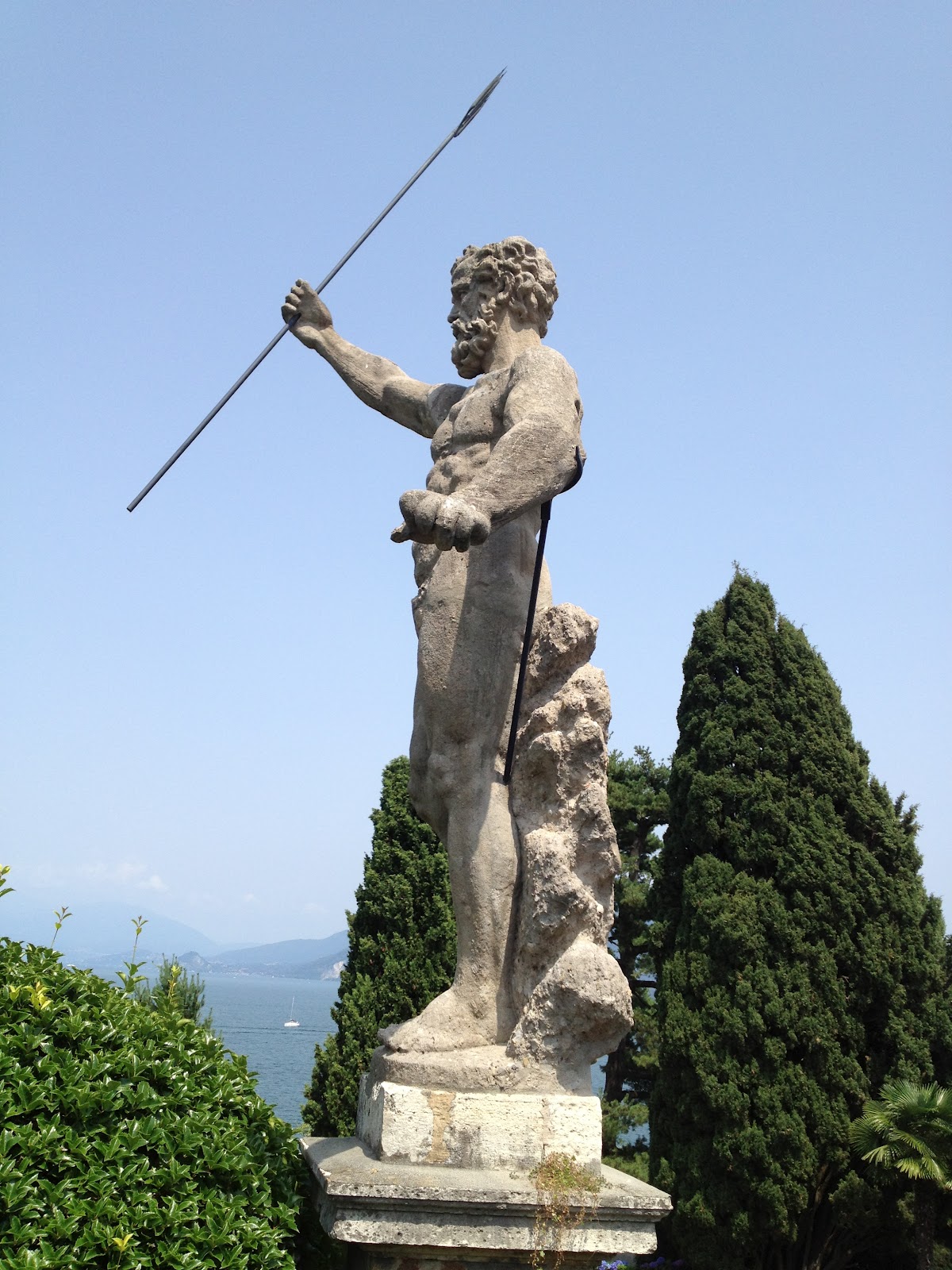
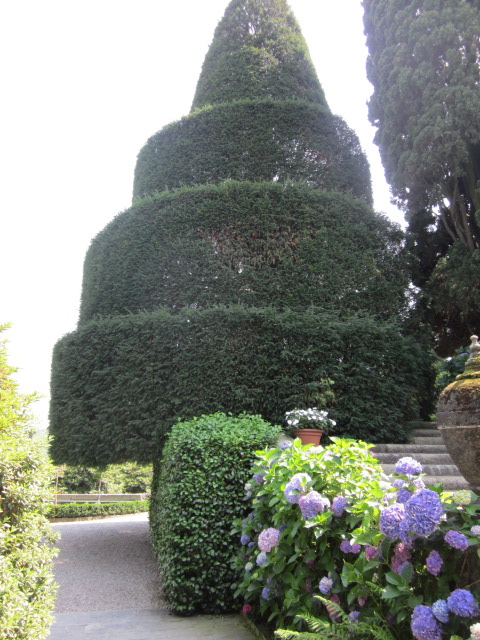
Outside, the palace at Isola Bella is surrounded by a lush green magnificence  gardens that are sculpted and ornamented with statuary and white peacocks wandering the premises as if they own the place.  

"After visiting the palace you enter the spectacular gardens which are on ten terraces and include an open air theatre which has statues depicting the four elements, the “Giardino del Amore” with geometrically designed hedging, water-lilies and citrus trees the Azalea Garden and the “Piano della Canfora” which is named for the 150-year-old laurel tree growing there. In English style garden, the “Giardino dei Fiori” you will find lotus flowers. At the highest point of the garden you will see a great unicorn which is the symbol of the Borromeo family."  [from visitstresa.com]

                
                 This is flanked on each side by a staircase. 
Didn't get to see this bird flaunt its  plumage.


Each direction you look has something of beauty to see and the statues are complemented by tall cone-shaped evergreens against a backdrop of gorgeous lake waters and mountain peaks in the distance.  In each corner of the terraced place there are hidden gems — a bird aviary, a lovely chair of stone carved to look as if it were made of branches, and a sweet gift shop and small cafe.

We enjoy the rest of our visit — wandering the grounds, admiring all we see.  Marilyn has been waiting for us outside the palace (having seen it many a time before) and before we leave, I walk down the stone embankment to step into the blue-green waters that are cool to my feet after so much walking, walking, walking.


Back in the village of Stresa we stop for delicious gelato, granitas, and a little shopping.  I'm pleased to find a small shop — Dubois — that specializes in toys and games for children but has some lovely inexpensive jewelry. 


I survey the gorgeous vistas all around us on the boat ride back to catch our train — all in all — a wonderful, wonderful day.

Thursday, August 16, 2012

Isola Bella

                     E-SO-lah BELL-lah ... doesn't it sound beautiful? 

And that is its name  “Beautiful Island”  and that it is.  Built over the 17th century, this island summer palace of the Borromeo family can be reached from Milan by an hour's train ride and plus a short boat ride from the shores of Lake Maggiore and the village of Stresa

We set off in the morning and arrive just in time to have lunch in a small café perched on the edge of the island’s rocky border. When I ask the waitress if we can sit at the table closest to the water she shakes her head, “Soon the water will be splashing you there.” And midway through our lunch I see she’s right as the lake waters are lapping at the edges of the railing!  This was the view. 


After lunch, we pass by narrow alleys and stone stairways to find the home built by the Borromeos and enter a stunningly beautiful opulent world that is Napoleonic in feel. Everything is grandiose. From the paintings to the table settings to the gold-leafed furniture, nothing in my experience can identify with the richness of the life these people have lived. 


Very high dome-ceilinged halls and galleries with marble and this glorious elaborate decoration and trim.  You are dwarfed by the size of these rooms.  You are in awe of the pilasters and pediments adorning and crowning every surface.  Outside every window is an amazing view and inside, each room and every wall amaze you  none more than the "grotto" of the palace  the below ground level rooms magnificently encrusted in black and white sea shells and stones. [Photos at the link.]


With posts  at least 14 feet-high wrapped in silver-embroidered pink velvet  a canopy bed sits majestically in the bedroom 
opposite wide-open tall glass French doors that frame the most picturesque vistas.  


How could anyone ever sleep in such splendor?


This photo by Chris.

Next time, we'll step outside to the gardens of Isola Bella...

Sunday, August 12, 2012

Milano

My sister-in-law’s best friend from college, Marilyn, had been living in Milan for years  first on and-off and now pretty much full-time  lucky for us we would staying with her and her husband Doug. To give you a sense of the size of their place, let me say this  the hallway of this enormous apartment was like an extra-long beautifully polished lane of a bowling alley. The living room had three sofas in a U-shaped arrangement; each was at least seven or eight feet long! It was perfectly lovely, wonderfully comfortable, and welcoming. 

When you go to Milan there’s one sight that is central to everything else: The Duomo. Now there are duomos and duomos and duomos throughout Italy (more duomos than drugstores it seems) but this is THE duomo in Milan and it is magnificent. I’d been there more than 25 years before and climbed to the top with my friend Carol and spent an incredible afternoon perched out on the marble roof while eating our lunch amid the gargoyles and angels. This visit I took “the lift” instead of the 200+ steps and stared out past the statues over the rooftops under the broiling sun. 


On top of each spire is full-sized statue! 


Once inside the cool cathedral my eyes naturally look down at the unbelievably beautifully inlaid floors...


You can’t do Milan and not see The Last Supper by Leonardo da Vinci. Groups of 25 are ushered in to a big hall to gaze upon the frescoed on a wall at the surprised faces surrounding Jesus’ table as he tells his disciples that one of them will betray him. At the other end of the hall in the Santa Maria delle Grazie, there’s another magnificent fresco of the Crucifixion. Technology will bring these views to you at this link.

Though the Brea is the largest museum of Milan we opt for seeing the 
Ambrosiana Pinacoteca (art gallery) and Biblioteca (library) instead  and while I can't remember all that we saw there, the outstanding exhibit was the Codex Atlanticus, a collection of over 1700 pages of DaVinci's drawings portraying inventions and people and of course the flying machines, Ventricular man, anatomy, levers and pulleys  but also the position of the moon, sun and earth, cranes and screws, light and shadow, even a plan for a series of canals to connect places in Florence.  Yes, the man was a genius and it was genius of the sculptor Pompeo Leoni to collect this trove of Leonardo's work in the 1500s for us to be dazzled by today.

Everyone says Milan’s so industrial but I love it. It’s a great mix of old and new — perfectly depicted by the Museo di Milano e Storia Contemporanea exhibits in the Palazzo Morando, housing the Countess Bolognini's collection of porcelain, sculptures and other objects in what were her private apartments as it was during the Napoleonic era.

Juxtaposed with this opulent look at the past are the marvelous contemporary exhibits on the ground floor.  We were lucky enough to see the fabulous designs in conjunction with the Woolmark Company  celebrating the look of wool.


Chess anyone?
Check out those mitten-pockets!
This array of creative clothing is helping this place live up to its name (the Museum of Contemporary History)  because today  the title of "Fashion Capital of the World" belongs  in large part to Milano.  

On to Lake Maggiore...